Pages

Showing posts with label Guide. Show all posts

Tuesday, October 16, 2012

Building your wardrobe: the essential tie(s).

So we've covered the shirt and the pants in our "essentials" series; time to move on to the tie! Because our goal here is to give helpful suggestions for additions to your wardrobe, and not to establish a uniform for men everywhere, we're going to provide several "basic" tie suggestions. All of these are classic and would be a solid addition to your wardrobe...add all of them for some variety that will cover you for all situations!

Before we list our specific suggestions, a few general tie tips. First, know what tie width you want. These days, the "mainstream" tie width is about 3.5".  Get much wider and you'll look dated; go 3" or below and you'll look trendy. What width you want is up to you, but a commonly-observed rule is to wear a tie that is about as wide as the lapels on your suit coat or sportcoat. This helps keep everything proportional.

Second, know that silk ties can be bought woven or printed. Woven means that the pattern is woven with differently-colored silk, while printed means that the pattern is printed on the same silk cloth with differently-colored dye. There are high-quality ties available that are made with either method. Our own preference tends to be for woven ties, as they give the pattern more depth and interplay with the light, but we'll buy a quality printed tie, as well.

Third, buy your ties from thetiebar.com. Their ties are the best bang for the buck you're going to find: made from substantial silk, many of them woven, for $15 each. These are better ties than you'll find in most department stores for $40-$60. Many of their ties are offered in different widths, depending on your personal preference.

Okay, on to the recommendations.

The Repp Stripe


"Repp" actually refers to the pattern of the weave of these ties. Their different stripes originally denoted membership in different military units, clubs, or universities. Find stripes in your school colors or favorite colors and wear this classic English tie that was later adopted as part of American Ivy League or prep style.

The Pindot Tie


More formal than the repp tie, the pindot will be appropriate in any setting with your suit, or it will dress up your sportcoat. 

The Grenadine*


Okay, the asterisk is because this version isn't actually a grenadine tie, which is more expensive. This is the Tie Bar's "Grenafaux," which gives much the same visual effect at a fraction of the price. Although this may be the most formal of these three ties, it is also the most versatile. You'll never go wrong wearing it.


Sunday, July 15, 2012

Building your wardrobe: the essential pants.

We started this series with shirt advice, so now let's move down to the pants. We'll assume you already have serviceable chinos/khakis in your wardrobe. Those are great for everyday casual or dressed-down office wear, but it's time to add another basic that can be dressed-up more than chinos: gray wool trousers.


Like chinos, gray wool slacks are highly versatile. While there are many situations where chinos or gray wool slacks could be worn equally well, chinos also occupy the more casual end of the spectrum (t-shirts) while gray wool serves the more formal end (coat and tie). Thus, with these two types of pants in your closet you will have every situation short of "suit required" covered.

Now, there are some US climates where one medium-weight pair of gray wool slacks will suffice. The Midwest is not one of those places. Our extremes of heat and cold mean that you will actually want to obtain two pairs of gray wool slacks: a lighter summer-weight pair (look for "tropical weight" wool) and a heavier winter-weight pair (flannel is good here). Color-wise, we would recommend a deeper charcoal shade of gray for the winter pair and a lighter shade for the summer pair.

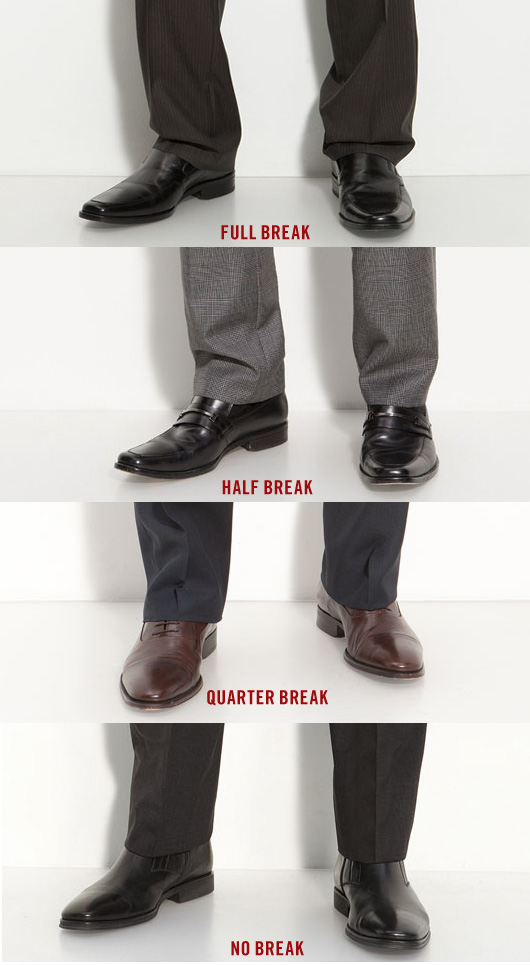
While we're on the topic of pants, here are a few pointers to keep in mind when shopping for them. Plain-front trousers are the standard these days. If you really want to go with pleats, try to stick with a single pleat and as trim a look as you can find. Pleated slacks should be worn higher than plain-front pants: this is how pleated slacks are designed and will help keep the pleats from puffing out. The general rule of thumb is cuffs with pleats and plain hems with plain front trousers, although the weight of cuffs can help maintain a good line on any pair of pants. When you're having your slacks cuffed or hemmed, you'll need to tell the tailor how much break you want, which determines how much of your shoe is covered by the slacks and how much extra fabric bunches at the bottom. You'll probably want to ask for a slight (quarter) or medium (half) break.   No break is a popular look in some quarters these days, but will definitely attract attention in the Midwest. Whatever you do, avoid the full break, which can look sloppy. (Remember this when selecting the length of pre-finished pants, as well.)


Thursday, June 14, 2012

Building your wardrobe: the essential shirt.

So let's get into some specific recommendations for building your everyday business/upscale casual wardrobe, assuming it currently is based on the short-sleeve polo shirt and khakis. We'll approach this from the standpoint of the first purchase we'd make if we were looking to make some upgrades.

It may not be a no-brainer, but it's pretty close: find and purchase at least one quality blue oxford cloth button-down (OCBD, for short) shirt. You'll be hard-pressed to find a more versatile workhorse for your everyday wardrobe. The no-iron or pressed versions are a classic look with a tie, wool slacks, and blazer on the high end. Or pair it with some chinos for your business casual look instead of a polo. When the weekend comes, forget the iron, embrace the rumpled look, and roll up the sleeves and wear it with some shorts. Once broken in, it's hard to beat the oxford cloth shirt for comfort and durability.

Where to buy? The classic is from Brooks Brothers, but it's also pricey. Lands' End and L.L. Bean have more affordable options. You can find used shirts from all three at your local thrift store or on eBay. Sources like Lands' End Canvas provide more trendy offerings (slimmer fit, smaller collar). If you find yourself in New York, check out the Uniqlo version, which has good reviews. Polo Ralph Lauren and Tommy Hilfiger also have OCBD's, although purists take issue with their visible logos. Even bargain retailers like Old Navy or Target usually have blue oxford cloth offerings.

Personally, we've been well served by the Lands' End versions. One consideration of buying a blue OCBD is finding the proper shade of blue. We would avoid the deeper french blue, which calls to mind the late 90's/early 2000's trend toward that shade. Opt instead for a lighter blue. Our favorite is a weave that uses coarser medium blue and white threads to produce a shirt that reads lighter once you're about a foot away.

Avoid.

Okay.

Our favorite (buy from Lands' end here).

Finally, we would note that we're not the only ones who have this preference for the blue oxford: more prominent men's style sources share our sentiments. So whether you go the affordable or upscale route, this is an easy first step toward achieving classic men's style.

Sunday, April 22, 2012

Finding your style.

Everyone has a style, in the loosest sense of the word, because everyone has a certain manner of dressing and presenting himself. What we're talking about here is finding style, in the sense of being a person who knows how to dress well. Dressing well is not equal to dressing expensively. An inexpensive suit worn well speaks more to your ability to dress than an expensive suit worn poorly. Dressing well means giving thought to your outfit, putting together elements that complement each other, and wearing your ensemble in a way that shows you care about your appearance.

One of the benefits of living in the Midwest is that it's easier to upgrade your style. It's not as difficult to improve your dress relative to those around you, because most men around here are content with their khakis and polo shirts. Trends do not change as rapidly here and tend to arrive later, if at all.  You can adopt a traditional approach to dressy clothing and be confident that most elements of your wardrobe will remain appropriate for some years, leaving you the flexibility to incorporate some trendier items as you desire into your base collection. Of course, you can also adopt a trendier approach if you find that's what you like, and it will be easier because you'll have to worry less about the constant game of one-upsmanship that can take place in those areas where everyone's striving for trendy.

So how do you go about figuring out where you want to head with your style? Open your eyes: pay attention to what guys are wearing on TV or in movies. Buy some magazines like GQ or Esquire and flip through them. Browse some street style blogs or some men's style blogs.* Go down to the Plaza or your local shopping center and stroll through different stores, browsing their displays. Take note of what you like and use those ideas to help direct you in your determination. Once you've done this, you should have some idea of labels and stores that carry items you're interested in incorporating as part of your style.

* Keep in mind that many of the examples in magazines or on blogs will be more "cutting edge" (some might say "extreme"). You may not want to head out and try to recreate the entire outfit, but at least take note of particular elements you'd like to incorporate into your wardrobe.